Showing posts with label writers. Show all posts

Friday, September 04, 2026

Always wit, often wisdom, under a heavy cloud: Dorothy Parker

When they told her that the taciturn ex-President Calvin Coolidge was dead, she said, "How could they tell?"

Dorothy Parker never like the monicker or the reputation she had acquired as a "wisecracker," but that is indeed what she was. She was more, however. She was a poet, critic, screenwriter, and political activist, and as a writer she had a major impact on her time and place.

She was also a victim of alcoholism and depression and dealt with these conditions for most of her adult life. She made several attempts at suicide -- most of them thought to be half-hearted -- and went through many broken relationships. Her leftwing politics eventually got her blacklisted from Hollywood.

All the while, she continued to write and crack wise:

You can lead a horticulture, but you can't make her think.
 
Men seldom make passes At girls who wear glasses.
 
If you have any young friends who aspire to become writers, the second greatest favor you can do them is to present them with copies of The Elements of Style. The first greatest, of course, is to shoot them now, while they’re happy.
 
I'd like to have money. And I'd like to be a good writer. These two can come together, and I hope they will, but if that's too adorable, I'd rather have money.
 
I hate writing, I love having written.
 
If you want to know what God thinks of money, just look at the people he gave it to.
 
I don’t care what is written about me so long as it isn’t true.

The fact was that Dorothy Parker was a good writer, maybe even a great one. She received two Academy nominations for her screenplays, and her poetry is still read and honored. She died in 1967, but she is not forgotten. (For more on Parker and other off-kilter writers, check out Andrew Shafer's Literary Rogues: A Scandalous History of Wayward Authors.)


Monday, August 31, 2026

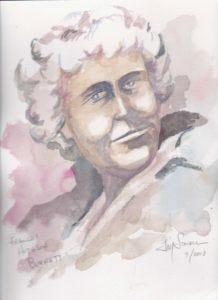
Frances Hodgson Burnett, a rock-star writer of the 19th and early 20th century

When the serialization of Little Lord Fauntleroy was published in 1885, it was so wildly popular that readers waited breathlessly for the next installment and stood in line to buy copies of St. Nicholas magazine in which the episodes appeared. The story set off a fashion trend that eventually became the basis for the Buster Brown clothing line. The episodes were gathered together into book form in 1886 and became an international best-seller; the book was translated into 12 languages.


Frances Hodgson Burnett, another of The Secret Garden and Little Lord Fauntleroy, wrote prolifically and made a ton of money doing it. She traveled extensively, lived peripatetically, spent extravagantly, and maintained a lavish lifestyle that most of us could only imagine.

During her 30 years atop the world’s literary stage, she was one of the world’s most famous women.

Burnett was, indeed, the J.K. Rowling of her day.

We remember Burnett for her children’s books today, but during her time, she also wrote best-selling adult fiction and highly popular stage plays. Little Lord Fauntleroy was turned into the stage play title The Real Little Lord Fauntleroy. Burnett had discovered that an unauthorized version of the book was being produced in a London theater; she then pursued and won a ground-breaking lawsuit for copyright infringement. The play she wrote went on to make as much money as the book did.

Burnett was born in Manchester, England, in 1849, but the family moved to Knoxville, Tennessee, during her teenage year, to be close to an uncle. After the Civil War, however, Knoxville could offer them little in the way of economic opportunity, so Frances took up writing to try to earn an income. She sold her first story to Godey’s Lady Book in 1868 and thereafter worked manically at her writing, often sacrificing her health to keep up a steady income.

Frances married Swan Burnett, a Knoxville neighbor, and they eventually left Knoxville to live in Washington, D.C. There she became famous for the literary salons she hosted on Tuesday evenings, which the rich, famous, and politically powerful attended. She also had two sons on whom she lavished attention. Vivian, the younger son, was the model for Little Lord Fauntleroy. The marriage ended in divorce, as did her second marriage.

There is much more to her life’s story that what I have been able to relate here. She has been the subject of at least two major biographies:

Thwaite, Ann (1991), Waiting for the Party: The Life of Frances Hodgson Burnett, 1849–1924, David R. Godine, ISBN 978-0-87923-790-5

Gerzina, Gretchen (2004), Frances Hodgson Burnett: the unexpected life of the author of The Secret Garden, Rutgers University Press, ISBN 0-8135-3382-1

In 2018, as writer-in-residence, I lived with Burnett and her work for several months as we at the Blount County Public Library decided to issue a new edition of The One I Knew Best of All, Burnett’s autobiographical novel of her childhood. The book is now available here on Amazon.

Monday, August 24, 2026

Antonia Fraser's writing day

 Fortunately for writer and historian Lady Antonia Fraser, she was pronounced as "uppity" when she was a girl attending convent school. The nuns, for some reason she doesn't specify, didn't like her.

They decided to punish by making her spend her Saturday mornings learning to touch type.

"In consequence," she writes, "I’m a touch typist – actually the most useful skill I ever acquired; so much for uppishness."

Fraser walls herself off for three hours in the mornings and writes "ferociously." Then she stops, has lunch, exercises and does other things in the after. In the late afternoon, she edits and revises what she had done in the morning, but it's at a much more languid pace.

The reason that this pattern of work-in-the-morning-only is something so deeply ingrained in me, is that I began trying to write history seriously when I had six children born in 10 years. I have actually written all my life, but history was It. So I devised a way of working like a bat out of hell, or anyway a bat out of the nursery, the moment I could cram the children into cradles, kindergartens, schools ... with the wild hope they would stay there. (There are wicked stories of notices on my door saying “Only come in if you have broken something”, which I utterly deny.) Under the circumstances, I never ever suffered from writer’s block. Source: Antonia Fraser: ‘I was forced to learn typing as a punishment for being uppish’ | Books | The Guardian

All this comes from a brief and delightful description that Fraser gave of her day to The Guardian a couple of years ago. If you are interested in how a good writer writes, you will want to read this.

Fraser is the author of many tomes of history (Mary Queen of Scots, Cromwell The Lord Protector, Marie Antoinette: The Journey, etc.), a couple of memoirs, and a detective series -- among other works. S]Now in her nineties, she still writes and gives her full powers to it.

Tuesday, August 11, 2026

Dominick Dunne on the best writing advice


The best advice on writing was given to me by my first editor, Michael Korda, of Simon and Schuster, while writing my first book. ‘Finish your first draft and then we’ll talk,’ he said. It took me a long time to realize how good the advice was. Even if you write it wrong, write and finish your first draft. Only then, when you have a flawed whole, do you know what you have to fix.

Dominick Dunne

Sunday, August 09, 2026

A visit with some old "friends"

 I am taking this late summer period to visit some old friends and to try to find some new ones. Author friends, I mean. I am returning to some authors I have read before and reading some of the publications that I have missed. One of those old "friends" is Walter Mosley, a writer of extraordinary talent and range. I had read several of his Easy Rawlins mysteries and just finished his first Joe King Oliver book. 

Mosley's writing drives straight into the action and holds you there until he is finished with you. So much of what I read these days is filler material — descriptions and items peripheral to the plot. Mosley doesn't write like that. His work puts you in the middle of the action and manages to keep you there even when he's spinning out a back story. Good stuff and highly recommended.