Saturday, August 29, 2026

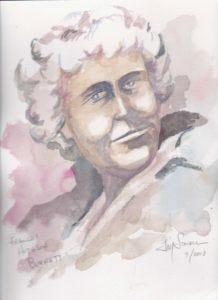
The scientific contributions and botanical art of Beatrix Potter

 All the world knows Beatrix Potter as the author of the Peter Rabbit stories.

As a 30-year-old woman, Potter tried to break through the Victorian-age social norms that precluded a female from being considered adequate as a scientist. She even wrote a scientific paper on mushrooms but in 1897 was refused the opportunity to present it to London's Linnean Society, the chief gathering of Victorian botanists, on the grounds that her ideas could not measure up to a male's observations. Her drawings were dismissed out of hand.

Some of the world knows that Potter also illustrated those stories. Probably even fewer people know that Potter was a scientist and a scientific artist, and her specialty was mushrooms.

As Maria Popova of BrainPickings writes:

. . . no aspect of Potter’s kaleidoscopic genius is more fascinating than her vastly underappreciated contribution to science and natural history, which comes to life in Linda Lear’s altogether magnificent Beatrix Potter: A Life in Nature . . . — by far the best book on Potter and one of the finest biographies ever written . . . The little-known scientific contributions and mushroom drawings of "Peter Rabbit" creator Beatrix Potter

Subsequent generations of scientists recognized the error and unfairness when, a century later, the Linnean Society issued an apology.

But Potter, undaunted, moved on. Four years later, in 1901, she self-published a book about four little rabbits. The next year, that book had morphed into The Tale of Peter Rabbit, which became a huge and enduring commercial success. She continued her writing and artwork, growing more famous and wealthy.

Her exquisite botanical drawings still exist, fortunately, and you can see some of them here, or take a look at Anne Stevenson Hobbs' book The Art of Beatrix Potter.

Friday, August 28, 2026

King James I, perpetrator of a Biblical translation, hunter of witches

 The famous opening scene of The Tragedy of Macbeth by William Shakespeare begins with the speeches of three witches. They predict what will happen in the play, but they are more than a dramatic device. They were a very pointed and obvious political statement.

That statement -- something of a cheerleader's "We're with you all the way!" shout-out -- was pointed directly at King James I.

We remember King James as the man who authorized the most famous translation of the Bible in history -- the King James Version. He not only authorized it; he sent some specific directions to the translators and monitored its progress, and that work can easily be compared to the work of any modern best translation services agency.

But there is another side to James that we forget today. He believed in witches and witchcraft and did his best to stamp it out both in Scotland, where he reigned as James VI and in England after he was crowned as James I in 1609.

James' belief in witchcraft and his campaign against it is outlined in an interesting article in HistoryExtra, the website of the BBC History Magazine and BBC World History Magazine. The article is Shakespeare’s Macbeth and King James’s witch hunts  and was written by Tracy Borman), who has authored a book about King James's attitude toward witchcraft. (Witches: James I and the English Witch Hunts )

James’s obsession with witchcraft can be traced back to his childhood. The violent death of his mother, Mary, Queen of Scots, seems to have inspired a dark fascination with magic. “His Highness told me her death was visible in Scotland before it did really happen,” related Sir John Harington many years later, being, as he said, “spoken of in secret by those whose power of sight presented to them a bloody head dancing in the air”.

The article is a fascinating account of the James we may have thought we knew.

Thursday, August 27, 2026

Left-brain-right-brain: Time to get a new theory

 You probably run into the left-brain-right-brain theory of behavior a lot, as I do. It's undoubtedly a popular way to explain why people are different.

The left side of the brain is the analytical side; the right is the creative side. Or maybe I have that backward. Anyway, one side is supposed to be dominant, and that determines how we see the world and how we behave.

The problem with that neat little concept is that it's nonsense.

The brain and its functions are far too complex to be explained by this simplistic formulation. As Stephen M. Kosslyn, Ph.D., (psychologist and neuroscientist) and G. Wayne Miller (author) write in this Psychology Today article:

Neuroscientists have known for a long time that research does not support such sweeping claims about how people differ in their left and right sides, or hemispheres. The functions of the hemispheres are in fact different, but these differences aren’t what the popular culture holds to be true -- the differences lie in how each side processes very specific kinds of information. Example: The left hemisphere processes details of visible objects whereas the right processes overall shape. The left hemisphere plays a major role in grammar and decoding literal meaning whereas the right plays a role in understanding verbal metaphors and decoding indirect or implied meaning. And so forth. Hardly the sort of stuff that can guide your life! Source: Left Brain, Right Brain? Wrong | Psychology Today

Read the whole article, or maybe this one: The Truth About Being Left-Brained or Right-Brained.

If you're subscribing to this theory, it's time to get a new one.

Wednesday, August 26, 2026

Appalachian language and other myths about the region

 You've probably heard this rural legend (as opposed to urban legend): The people of Appalachia speak a dialect of English that harkens back to the English of Chaucer; it's older even than the English of Shakespeare.

No, they don't.

Just as everyone else's English has done, the English of rural Appalachia has constantly evolved and is the product of multiple influences.

That's the argument that Chi Luu, a computational linguist, makes in an interesting and arresting article in JSTOR Daily: The Legendary Language of the Appalachian "Holler" | JSTOR Daily

Language has an important place in the folklore of Appalachia and has evolved to become something quite different from its original linguistic sources. It’s one of the ways Appalachian communities show solidarity and belonging. Language lovers may marvel at this unique linguistic quilt, a thing of threads and patches, that extends across a region that often seems to have little else going for it. But in some ways, the folksiness, the romanticized hearkening back to the past, holds the region back from telling a more nuanced story about itself, where it came from, and where it might be going.

Luu posits that Appalachia should be recognized for its diversity -- cultural as well as linguistic -- rather than being thought of as fiercely and exclusively white descendants of Scots-Irish stock. Movement in and out of Appalachia was just as prevalent as in any other part of the country.

We may think of Appalachia as poor, rural, white, backward, and uneducated (and, in today's political climate, angry). But to do so makes us the fools rather than the people of this fascinating region. Or, as Luu puts it:

So the theory of the poor, white, rural Appalachian mountain men going it alone, preserving a pure and unchanging strain of archaic British English, isolated in a hardscrabble place far from civilization, could not be further from the truth. Without the influence of diverse communities of other Appalachians such as African American Appalachians, the southern Appalachian speech and culture simply would not be what it is today. To ignore their contributions to culture and language means Appalachia will always be a distant story, burdened by the myths and legends written by others, left half told.


Tuesday, August 25, 2026

'The Woman Who Smashed Codes' taught her biographer cryptology after her death

Journalist Jason Fagon, when he set out to write a biography of the extraordinary Elizebeth Friedman, America's chief codebreaker during World War II, had an obstacle to overcome that most biographers don't face: He had to learn cryptology, the art and science of secret writing.

Fortunately, Fagon had a good teacher: Elizebeth Friedman herself.

Friedman had been dead for more than two decades when Fagon began his research -- she died in 1980 -- but she had left much of her work in papers given to the George C. Marshall Research Library in Lexington, Virginia.

Fagon started by reading about cryptology and trying to get an idea of how it happened. He admitted in an interview with Fortune magazine that he didn't feel he had gotten very far.

But then this lucky thing happened, and I discovered a codebreaking manual written by Elizebeth herself, left behind in her personal archive. It’s an unpublished manuscript of a book she wrote for young adults, explaining how to break common types of codes and ciphers with a pencil and paper, in this very clear and encouraging and witty style. The spirit of the book is like: You can do it! Jump in! Have fun! It’s a game! Don’t be afraid! And it was perfect for me, as an amateur. That’s how I learned the basics of cryptanalysis, by reading Elizebeth’s own book and stepping through some of the example problems that she laid out. Elizebeth Smith Friedman: 'The Woman Who Smashed Codes'

Besides his willingness to dig into cryptology, Fagon had another advantage as a biographer: he had a spectacular and important subject that few people knew anything about. Friedman's life defies a short description.

She stumbled into cryptology after being asked by an eccentric millionaire to help prove that Sir Francis Bacon had written the plays of William Shakespeare. (He didn't, according to a book she and her husband wrote many years later.) This job led her to her working for the government during Prohibition, breaking codes of smugglers and testifying against them in court.

When World War II broke out for America in 1941, she became America's chief cryptanalyst, breaking Nazi and Japanese codes and helping the FBI track down Nazi spies throughout North and South America. Because her work was often classified and because she was a woman, and a modest one at that,  FBI director J. Edgar Hoover never gave her the credit she deserved for her work.

Fagon's book, The Woman Who Smashed Codes: A True Story of Love, Spies, and the Unlikely Heroine Who Outwitted America's Enemies, published in 2017, has helped to correct that injustice. The book has become a best-seller and was named as a National Public Radio Best Book of the Year. Stuart Smith's biography, A Life in Code: Pioneer Cryptanalyst Elizebeth Smith Friedman, is available at WorldCat at this link.


Monday, August 24, 2026

Antonia Fraser's writing day

 Fortunately for writer and historian Lady Antonia Fraser, she was pronounced as "uppity" when she was a girl attending convent school. The nuns, for some reason she doesn't specify, didn't like her.

They decided to punish by making her spend her Saturday mornings learning to touch type.

"In consequence," she writes, "I’m a touch typist – actually the most useful skill I ever acquired; so much for uppishness."

Fraser walls herself off for three hours in the mornings and writes "ferociously." Then she stops, has lunch, exercises and does other things in the after. In the late afternoon, she edits and revises what she had done in the morning, but it's at a much more languid pace.

The reason that this pattern of work-in-the-morning-only is something so deeply ingrained in me, is that I began trying to write history seriously when I had six children born in 10 years. I have actually written all my life, but history was It. So I devised a way of working like a bat out of hell, or anyway a bat out of the nursery, the moment I could cram the children into cradles, kindergartens, schools ... with the wild hope they would stay there. (There are wicked stories of notices on my door saying “Only come in if you have broken something”, which I utterly deny.) Under the circumstances, I never ever suffered from writer’s block. Source: Antonia Fraser: ‘I was forced to learn typing as a punishment for being uppish’ | Books | The Guardian

All this comes from a brief and delightful description that Fraser gave of her day to The Guardian a couple of years ago. If you are interested in how a good writer writes, you will want to read this.

Fraser is the author of many tomes of history (Mary Queen of Scots, Cromwell The Lord Protector, Marie Antoinette: The Journey, etc.), a couple of memoirs, and a detective series -- among other works. S]Now in her nineties, she still writes and gives her full powers to it.

Sunday, August 23, 2026

Get healthy, happy, creative, and smart: get up and . . . stride

 The benefits of walking as an exercise are well-known and well-document. Besides, it's easy to integrate with life activities and requires no special facility or equipment.

But does it make us smarter? more creative? happier?

Shane O'Mara, a neuroscientist and author of the book In Praise of Walking, believes that it does and cites evidence -- both scientific and anecdotal -- that it does.

Walking around the mall or the park or wherever we happen to do it awakes the spatial functions of the brain that forms of stationary exercise do not. The things that we see and take in while we are walking put us in a different place, both figuratively and literally.

And that, in turn, can change our outlook and personal habits and attitudes. O'Mara's thoughts on walking are contained in an article (published several years ago) by Amy Fleming in The Guardian:

He cites a 2018 study that tracked participants’ activity levels and personality traits over 20 years, and found that those who moved the least showed malign personality changes, scoring lower in the positive traits: openness, extraversion and agreeableness. There is substantial data showing that walkers have lower rates of depression, too. And we know, says O’Mara, “from the scientific literature, that getting people to engage in physical activity before they engage in a creative act is very powerful. My notion – and we need to test this – is that the activation that occurs across the whole of the brain during problem-solving becomes much greater almost as an accident of walking demanding lots of neural resources.” Source: ‘It’s a superpower’: how walking makes us healthier, happier and brainier | Life and style | The Guardian

This is a fascinating article, especially for someone like me who has always been a dedicated walker. My wife and I usually walk twice a day and cover between three and five miles. We do this every weekday, and on weekends, because of altered schedules, we do less.

We walk in the same places -- we have two designated spots in different parts of town, one of them a lovely park with lots of trees, greenery, and streams. We go at a fairly rapid pace -- striding, you might say -- and even though we walk in the same place, it's never the say.

So, I think there is a lot to what O'Mara has to say. Read this article and see what you think.


Saturday, August 22, 2026

Bouton's 'Ball Four': a book that afflicted the rich and comfortable of the baseball world

 When someone writes a book that thoroughly offends and discomfits people who are well off, in positions of influence, rich, and comfortable, it should merit our attention.

That was the case when Jim Bouton, briefly a star pitcher for the New York Yankees, wrote his tell-all memoir Ball Four that centered on stories from inside the locker room of the then most successful team in Major League Baseball.

When it was published in 1970, “Ball Four,” which reported on the selfishness, dopiness, childishness and meanspiritedness of young men often lionized for playing a boy’s game very well, was viewed by many readers, either approvingly or not, as a scandalous betrayal of the so-called sanctity of the clubhouse. Source: Jim Bouton, Author of Tell-All Baseball Memoir ‘Ball Four,’ Dies at 80 - The New York Times

Bouton was thoroughly excoriated by the likes of Bowie Kuhn, commissioner of Major League Baseball, and Dick Young, baseball columnist for the New York Daily News and dean of baseball writers at the time. Young wrote:

People like this, embittered people, sit down in their time of deepest rejection and write. They write, oh hell, everybody stinks, everybody but me, and it makes them feel much better.

Not everyone was offended.

Some astute reviewers recognized the ardor and the poignant tension in Bouton’s tale; in The New Yorker, for instance, Roger Angell described “Ball Four” as “a rare view of a highly complex public profession seen from the innermost inside, along with an even more rewarding inside view of an ironic and courageous mind. And, very likely, the funniest book of the year.”

Bouton took Dick Young's criticism and turn it, somewhat, to his advantage. After the book was published, Bouton saw Young at spring training and decided to approach him in a gentlemanly fashion. They shook hands, and Young said, "Well, I'm glad you didn't take it personally." Bouton took that line and used it as the title of his next book, I'm Glad You Didn't Take It Personally, which chronicled the reactions to Ball Four.

Ball Four has since risen to the level of a classic tale, named as one of the 100 best sports books of all time by Sports Illustrated in 2002 and the only sports book in the New York Public Library's centennial exhibition in 1995.

Bouton died at the age of 80 in 2019. In addition to his authorship, Bouton lived an interesting and varied life that is chronicled in his New York Times obituary (Jim Bouton, Author of Tell-All Baseball Memoir ‘Ball Four,’ Dies at 80 - The New York Times).

Friday, August 21, 2026

Timothy Webster: The Pinkerton Who Paid the Full Price

Of all the agents that spymaster Allan Pinkerton ran during the Civil War, Timothy Webster was the most effective and the one who paid the highest price. 

An English-born detective who had worked for Pinkerton since the 1850s, Webster infiltrated Confederate networks in Maryland and Virginia with a skill and audacity that produced some of the most valuable intelligence of the early war years. He was caught in early 1862 and hanged in Richmond in April of that year — the first American executed as a spy since the Revolution.

Webster’s cover story was that of a Southern sympathizer, and he played it so convincingly that he was welcomed into Confederate social and political circles in Baltimore and Richmond. He was betrayed by two other Pinkerton agents who had been captured and, under pressure, identified him. Confederate authorities arrested him in March 1862 at his hotel in Richmond, where he was bedridden with acute rheumatism — so ill that he had to be carried to his trial and to the scaffold.

He was tried within days of his arrest and condemned to death. His execution on April 29, 1862, was attended by a large crowd and badly botched — the rope was improperly set and Webster had to be hanged twice. He died, by contemporary accounts, with composure. He was forty-five years old.

Pinkerton was devastated by Webster’s death and never quite forgave himself for the exposure that had led to his capture. Webster received little official recognition — the intelligence he provided had no formal government sponsor, and his death occurred at a moment when the Union’s attention was focused elsewhere. 

His name is not widely known. It deserves to be.

Thursday, August 20, 2026

Charlie Comiskey’s Real Legacy: The Owner Who Built the Fix

The Black Sox scandal of 1919 is almost always told as a story about eight corrupt players who threw the World Series. It is more accurately told as a story about what happens when an owner treats his employees as assets to be exploited rather than professionals to be compensated.

Comiskey had been a first baseman of genuine distinction in the 1880s. He became a manager, then an owner, and built the White Sox into one of the dominant teams of the American League’s early decades. He also paid his players among the lowest salaries in the American League while making himself rich from their labor. He charged players for cleaning their own uniforms. He promised bonuses and failed to deliver them. Eddie Cicotte had been promised a $10,000 bonus if he won thirty games; Comiskey benched him when he reached twenty-nine to avoid paying it.

The players’ discontent was real and documented. When Sport Sullivan, the Boston gambler, approached first baseman Chick Gandil with the proposition to throw the Series, he was pushing on a door that Comiskey had already opened. The promised payment — $100,000 — was nearly what the entire team was paid in salary for the season.

None of this excuses what the eight men did. They betrayed their teammates, their fans, and the integrity of a sport that thousands of people cared about. Commissioner Landis was right to act decisively. But the story that gets told — eight bad men corrupted by greed — omits the context that explains how they got there.

Comiskey died in 1931, his reputation intact, his plaque eventually in Cooperstown. The eight players — including Shoeless Joe Jackson, whose involvement remains disputed — remained banned. History, in this case, distributed its judgments unevenly. The man who created the conditions for the fix ended up in the Hall of Fame. The men who carried it out were permanently erased from the game.

Wednesday, August 19, 2026

Book Spotlight: The Unbroken Oath

When Virginia seceded in April 1861, Colonel Robert E. Lee chose his state over his oath to the Constitution. On the same day, another Virginian made a different choice. Winfield Scott, the 74-year-old commanding general, remained loyal to the oath he had taken fifty years earlier.

The Unbroken Oath: The Heroes History Forgot: Southern Officers Who Kept Their Oath to the Constitution tells the stories of Southern officers who chose duty over family, Constitution over state. George H. Thomas, a Virginian from a slave-owning family, kept his oath and was disowned by his relatives—they turned his portrait to the wall and never spoke to him again. David Farragut of Tennessee abandoned his Norfolk home and later led the Union fleet to victory at Mobile Bay. John Gibbon, raised in North Carolina, commanded Union troops at Gettysburg while three of his brothers fought for the Confederacy.

These men came from the South's most prominent families. They attended West Point. They owned slaves or came from slave-owning backgrounds. By every measure of culture and kinship, they should have joined the Confederacy. Instead, they kept their oaths—and helped save the United States.

The Lost Cause mythology required these men to be forgotten. If George Thomas—a Virginian who saved the Union army at Chickamauga and destroyed a Confederate army at Nashville—remained loyal to his oath, then secession wasn't the inevitable choice of honor. If 100,000 white Southerners fought in Union blue, then the South was never unified.

The Unbroken Oath reclaims these remarkable stories and honors the Southern officers who chose principle over convenience, even when it cost them everything.

Part of "The Civil War You Never Knew" series, available on Kindle Unlimited and in paperback.

Tuesday, August 18, 2026

What role does God want you to play? Grace for All, August 14, 2026

Note: This is a devotion for the Grace for All podcast that aired last week. Grace for All is a daily devotional podcast produced by the congregation of First United Methodist Church in Maryville, TN. It can be heard on the podcast plat 


Exodus 7: 1-5 (NIV)

1 Then the Lord said to Moses, “See, I have made you like God to Pharaoh, and your brother Aaron will be your prophet.

2 You are to say everything I command you, and your brother Aaron is to tell Pharaoh to let the Israelites go out of his country.

3 But I will harden Pharaoh’s heart, and though I multiply my signs and wonders in Egypt,

4 he will not listen to you. Then I will lay my hand on Egypt and with mighty acts of judgment I will bring out my divisions, my people the Israelites.

5 And the Egyptians will know that I am the Lord when I stretch out my hand against Egypt and bring the Israelites out of it.”

In this passage, we hear God speaking to Moses telling him what is about to happen with the Pharaoh of Egypt who is oppressing the children of Israel. In the words of Rabbi Andrew Mandel of Manhattan’s Central Synagogue, God seems to be a Hollywood director and casting agent, and He is giving the role of God to Moses.

Moses, we know from reading through Exodus, has protested to God that he does not want this role. He has a stutter, and he argues with God that this prevents him from being an effective leader. But God counters with the offer to Moses of Aaron, the brother who can, when necessary, speak on behalf of Moses. It is an offer that Moses cannot refuse.

I think this ancient story asks us today, “What role is God offering to us?” Does God simply want us to go about our business, keeping ourselves to ourselves, as they say? Our does God have something in mind – today – for us to do?

Our world is broken, divided, and in pain. So are the people around us. So are we on many occasions. We are prone to ask, “Where is God in all of this?” and then wait for God to show up. In this passage, God is asking Moses to play the role of God. Could he be asking us to do the same thing? Could he be asking us to say the kind word, to offfer a loving smile, to give assistance to someone in need, or to present the gift of our time and attention to a person or situation that is right in front of us?

It is not difficult to find those needs and people where we can be a loving and grace-filled God. We can play that role, as Moses did, if we respond to God’s casting call.

What role is God casting you for today?

Our prayer: Dear Lord, help us to hear your voice that calls us to be your voice, your hands, and your feet in the service of those around us. May we respond to that voice with joy and thanksgiving. Amen.

This devotion was written and read by Jim Stovall.

Listen to this episode

Monday, August 17, 2026

Josh Gibson: The Home Run King Nobody Counted

In the summer of 1937, Josh Gibson hit a home run at Yankee Stadium that landed in the upper deck in left field — a distance that no one in the history of the ballpark, before or since, had reached. There were perhaps 6,000 people in the stands. The game was a Negro League contest. The achievement was not reported in the New York papers.

Gibson was born in 1911 in Buena Vista, Georgia. He was discovered at seventeen, catching for a semipro team, when the Pittsburgh Crawfords needed an emergency catcher during a game and pulled him from the stands. He was, by every account, an immediate and obvious natural talent.

His career statistics are both extraordinary and unreliable. Negro League record-keeping was inconsistent, and the records that do exist have been compiled by researchers working from newspaper box scores and surviving documents. What the research supports is a career home run total that probably exceeded Babe Ruth’s 714, a batting average that appears to have been above .350 for most of his career, and a reputation among contemporaries as the greatest hitter any of them had ever seen.

Sunday, August 16, 2026

The weakening of the public school system

 As a believer in and a supporter of a strong public school system, I have found the loss of confidence in our public schools in general over the last 40 or so years to be a most disturbing aspect of American life today. Our public school system seemed to serve us very well since its inception in the early 19th century. Why it has fallen into some disfavor is a matter of concern to all of us whether or not we have children in the system.

Dana Goldstein, a reporter for the New York Times who covers education, has written extensively about this phenomenon and has recently posited these reasons a voucher system has become so popular and why parents are looking for more choice:

What’s driving this change? The pandemic prompted many families to reconsider how their children learn. Republican lawmakers embraced private-school choice as part of a broader push for parental rights. (They also see the issue as a way to appeal to young parents — often Black and Latino — who are critical of how public schools serve their children.) And teachers are reporting intense burnout, with some leaving public schools to open small businesses that can accept these vouchers.

Goldstein’s reporting is worth reading.

Despite these problems, I still believe that the nation is better off with a strong public school system that has the confidence of every part of society. Such a system will never be perfect or even perfectly acceptable, but it is certainly a goal worth pursuing.

Illustration: An abandoned schoolhouse

August’s Free Book: There Must Come a Change

NOTE: This is the book I am offering free to the more than 4,500 people on my newsletter list. If you want to join these folks, go to JPROF.com and sign up. 

Before Jackie Robinson, there were the Pythians.


There Must Come a Change Cover
In the summer of 1869, a team of young Black men took the field against white opponents in Philadelphia—the first recorded interracial baseball game in American history. They called themselves the Pythians, and their captain was Octavius Valentine Catto: scholar, athlete, Civil War veteran, and the most dangerous Black man in Philadelphia.

Catto and his teammates weren't just playing baseball. They were waging a campaign for equality, using athletic excellence to challenge the assumptions of a nation struggling to define itself after the Civil War. When organized baseball formally banned Black players in 1867, the Pythians applied anyway. When they were rejected, they kept playing—and kept winning.

There Must Come a Change tells the full story of this remarkable team: their undefeated 1868 season, their historic games against white opponents, and the tragic Election Day in 1871 when Catto was assassinated on the streets of Philadelphia while defending the right of Black men to vote.

Drawing on primary sources from the Historical Society of Pennsylvania and contemporary newspaper accounts, Jim Stovall brings to life a forgotten chapter of American history—one that connects the baseball diamond to the ballot box, and the struggles of Reconstruction to the long fight for civil rights that continues today.

This is the story of the men who challenged baseball's color line eight decades before Jackie Robinson—and paid the price for their courage.

Saturday, August 15, 2026

Upheld: The Supreme Court and Birthright Citizenship,

Upheld: The Supreme Court and Birthright Citizenship
, a full book about the controversy, was published in June just after the Supreme Court announced its decision. 

It is on Amazon now, in ebook and paperback, and is included in Kindle Unlimited. If you followed this case and wanted more than the news coverage could give you, this is the book I wrote for you. 

Here's the Amazon blurb:

She is known only as Barbara. A Honduran asylum seeker living in New Hampshire, she gave birth to a daughter in October 2025 — a daughter born on American soil, a daughter the president's executive order said was not an American citizen. On April 1, 2026, her case reached the Supreme Court of the United States. A sitting president attended the arguments, the first in the official record to do so. On June 30, 2026, the Court ruled.

Upheld is the complete story of Trump v. Barbara — the most consequential citizenship case in more than a century. It begins where the story actually begins: with the wreckage of Dred Scott v. Sandford in 1857, the drafting of the Fourteenth Amendment in the aftermath of the Civil War, and the landmark 1898 Supreme Court ruling in United States v. Wong Kim Ark that established birthright citizenship as settled constitutional law for the next 128 years. It traces the thirty-year political journey that carried the idea of ending birthright citizenship from the margins of American politics to a presidential executive order signed on the first day of a second term. It explains the originalist debate — the genuine, serious scholarly disagreement about what the framers of the Fourteenth Amendment understood themselves to be doing — and what was actually at stake for the more than 250,000 children born on American soil every year to parents without citizenship or permanent residency.

It closes with the ruling itself: a 6-3 decision written by Chief Justice John Roberts, a notable separate opinion from Justice Brett Kavanaugh that leaves a constitutional question unresolved, and the words with which the Chief Justice closed his opinion — "Citizenship, then and now, was the right to have rights... We keep that promise today."

Written and published within hours of the Supreme Court's decision, this is the book that could only exist after the ruling came down. The news covered the decision. This book covers everything that led there — and what it means.

The Backstory series. Because the event is just the ending.


Friday, August 14, 2026

Friends of Liberty podcast: all 36 episodes still available

 The complete Friends of Liberty podcast series remains available here at friendsofliberty.substack.com. This Revolutionary War series contains 36 episodes, all with stories about the war for independence that you have probably never heard. 

We dig deep and find the spies, the enslaved Americans, and the unsung heroes and heroines that historians have left behind. Thousands of people pledged their lives, liberties, and fortunes (people such as Agrippa Hull, pictured at right) to help this nation free itself from a king and an arrogant Parliament who thought they could tax and act with impunity. 

This podcast gives you just a few of their stories. Take some time during this 250th year celebration to find out more about these folks — people who should not be forgotten.

Published: Erasmus: Seven Things You Should Know


Erasmus of Rotterdam was supposed to be a monk. Instead, he became one of the most famous writers in Europe, rewrote the New Testament, made a bestseller out of a joke, and ended up trusted by neither side of the biggest religious split in a thousand years.

I'm no expert on Erasmus. But I went looking for what was most interesting, most surprising, and most useful to know about him — and came back with seven things I'm glad I know now.

Curious, a little lost, and taking notes.

Now on Amazon in ebook or paperback.

Thursday, August 13, 2026

The futility of suppression: the case of Baruch Spinoza

One of the enduring lessons that those in authority — or those who assume to have authority — never learn is the futility of trying to suppress ideas, even ideas that seem to be evil, harmful, or simply out-of-step with the tenor of the times.

One great example of this futility is the life of an obscure intellect who made his living during his all-too-short life as a lens grinder.

Baruch Spinoza was born on November 24, 1632, in Amsterdam, and was destined to become one of history’s most influential philosophers. He did so despite the fierce opposition of people who were once his family and friends but who ended up shunning him.

Of Portuguese-Jewish descent, Spinoza’s life and works are a testament to intellectual bravery and the relentless pursuit of truth. Despite living only 44 years, his ideas have had a lasting impact on philosophy, particularly through his magnum opus, Ethics. Spinoza’s radical philosophy, especially his concept of pantheism, drew severe opposition from religious and civil authorities, who made significant efforts to suppress his works.

And yet, Spinoza’s ideas have transcended time, influencing countless thinkers and contributing to the foundation of modern philosophy.

Spinoza grew up in the Portuguese-Jewish community of Amsterdam, a group of exiled Sephardic Jews who had fled the Inquisition. His early education was grounded in Jewish religious studies, but he soon expanded his horizons. Fascinated by the scientific and philosophical developments of his time, Spinoza began studying Latin and immersed himself in the works of René Descartes and other contemporary thinkers. This intellectual curiosity led to a break with traditional religious teachings, which culminated in his excommunication from the Jewish community in 1656. The cherem, or excommunication decree, described him as an “evil influence” and a “corrupter,” effectively severing his ties with his family and community.

Central to Spinoza’s philosophy is the concept of pantheism, the belief that God and the universe are identical. In his seminal work, Ethics, Spinoza argued that there is only one substance, which he called “God” or “Nature” (Deus sive Natura). According to Spinoza, everything in the universe, including human beings, is a part of this single substance. This view contrasts sharply with the traditional Judeo-Christian conception of God as a distinct, transcendent being who created and governs the universe.

Wednesday, August 12, 2026

Holbein: Painting the rich, the royal, and the well-connected

If you were anybody (as opposed to a nobody) in or around the court of Henry VIII (1491-1547), you wanted your portrait painted, and the guy you wanted to paint it was Hans Holbein.

Holbein’s near life-like characters and his ability to work with his subjects to project the image that they wanted netted him dozens of commissions and a very good living during his years in London.

Many of those portraits, including those of the king and his several wives, survive today and are currently on display in an exhibition at the J. Paul Getty Center in Los Angeles. Those who can’t get there in person can view the exhibition at the link below.

Here’s part of what the exhibition notes say about Holbein’s work:

In his portraiture Holbein immortalized a vibrant Renaissance culture of self-definition, luxury, knowledge, and wit. He devised inventive pictorial solutions for a variety of clients: celebrity scholars, ambitious merchants, and officials at the English court. Holbein achieved the powerful impression of presence and specificity by means of a flexible working process and rapport with his sitters. Some patrons demanded not just accurate likenesses but celebrations of their values, aspirations, and professional identities. Source: Holbein: Capturing Character in the Renaissance

Holbein was born in Augsburg, Germany, in 1497 (or thereabouts), the son of Hans Holbein, a well-known and respected painter of the time. The son eventually surpassed his father in fame, wealth, and artistic ability, so that today the father is known as Hans Holbein the Elder and the son as Hans Holbein the Younger.

The Younger moved to Basel, Switzerland in 1515, where he launched his career and enjoyed the vibrant culture of the time. That vibrancy turned to turmoil with the stirrings of the Protestant Reformation, and commissions for his work dwindled. Still, in 1523 he painted a portrait of the well-known humanist and writer Erasmus of Rotterdam—a portrait that made the painter famous. Not only did he paint portraits, but he also mastered the art of woodcuts, which had revolutionized the way books were designed and printed, and he achieved a good deal of fame for his work in that realm.

Holbein felt constrained by the growing conflicts in central Europe and in 1526 looked for a better environment in which to pursue his art.

London, he believed, was a town where he could stretch out his talents and make a good living, and he did just that. It didn’t hurt that he carried a letter of recommendation from Erasmus to his friend Sir Thomas More, then a close advisor to the King of England. More did his part by arranging commissions for the young painter, including one of his entire family. That painting doesn’t survive, but the preliminary sketches do. The group portrait was an original concept and would eventually gain acceptance throughout Europe.

Holbein went back to Basel in 1528 and stayed for about four years. During that time, Reformation conflicts again arose, and Holbein’s art was not universally admired or accepted. In 1532, he returned to London where the atmosphere was also politically charged but the king was in firm control. Holbein distanced himself from Thomas More and his humanist circle and found favor with the court’s rising stars, Anne Boleyn and Thomas Cromwell.

He traveled back and forth to Europe, painting portraits of the rich, the royal, and the well-connected. One of those was Anne of Cleeves. The portrait, which was said to be a flattering one, is thought to be one of the reasons Henry VIII chose her as his third wife after Anne Boleyn was executed. The king was disappointed with her appearance when he met her, but he never blamed Holbein. The fall of Thomas Cromwell from the king’s graces did damage his career, however.

Holbein died in 1543 at the age of 45. The cause of his death was probably the plague, although this is not known for sure. What is certain is the large body of work that he created and the influence on painting, particularly portraiture, that he left behind.

But Now I See: Photographs and Reflections on Grace

 Cliff McCartney

Cliff McCartney, good guy and good friend, has published a book of extraordinarily beautiful and meaningful photographs, each accompanied by a story and a meditation. The stories include the when and where of the photos, including occasional technical information, and the meditations are about what these pictures — and the process of photography itself —are teaching him about his life and faith. This is a wonderful book that you should take a look at for yourself and as a gift for friends,

Available on Amazon: https://www.amazon.com/But-Now-See-Photographs-Reflections/dp/B0H6GSMKQZ/ref=sr_1_1?

JPROF-First Inning Press newsletter


 Jim publishes a newsletter every Friday that contains a variety of articles, news about his books, and giveaways. The newsletter is free. You can sign up for it at JPROF.com.

Tuesday, August 11, 2026

Dominick Dunne on the best writing advice


The best advice on writing was given to me by my first editor, Michael Korda, of Simon and Schuster, while writing my first book. ‘Finish your first draft and then we’ll talk,’ he said. It took me a long time to realize how good the advice was. Even if you write it wrong, write and finish your first draft. Only then, when you have a flawed whole, do you know what you have to fix.

Dominick Dunne

Erasmus, the first professional writer

The theologian Erasmus of Rotterdam was, according to historian Thomas Cahill, the first person in modern times to make his living solely by being a writer. The assertion is arguable, but quite likely true.

Erasmus appeared on the world scene in the 1460s, the dawn of the printing age. In Western Europe, literacy was on the rise, and the hunger for the printed word was nearly insatiable. Erasmus could write, and write well. He wrote with facility and agility.

And Cahill, in his book Heretics and Heroes, not only credits Erasmus with being the first professional writer, but also with being the person who invented the best-seller.

Even if Erasmus had not been the first professional writer, or the first best-selling author, we would remember him today for the enormous contributions he made to the ideas and creativity of his time, and the long-lasting effects they have had. Along with his contemporary, Martin Luther, Erasmus had no equal as an intellectual giant.

Monday, August 10, 2026

The Nathan Tower Espionage Series

About the Series


In the years after the Civil War, the United States had no real intelligence service — and Commander Nathan Tower built one anyway.


Operating out of a modest post at the Office of Naval Intelligence, Tower assembles a network of operatives who work in the shadows of Gilded Age Washington, Europe, and the Americas: gathering secrets, running operations no one will officially acknowledge, and defending American interests against rivals who have been playing this game far longer. Tower himself rarely takes the field. He orchestrates — recruiting, training, and deploying operatives whose skills he understands better than they do themselves.


The Nathan Tower Espionage Series is historical spy fiction grounded in real events, real institutions, and real historical figures of the 1860s–1880s. Each book stands on its own — new readers can start anywhere — but longtime readers will find a network of characters, relationships, and consequences that deepens across the series.


The series can be read in any order, but for readers who want the full arc, the suggested order is below: the prequel novellas first, then the main sequence of novels, with the short story collection filling in the gaps between them.

READ MORE ABOUT THE SERIES HERE 


Sunday, August 09, 2026

New from the I'm No Expert, But series: Bletchley Park.


You've probably seen a movie about this. Here's what the movie left out: the Polish mathematicians who broke Enigma first, the Americans who showed up with a codebreaking machine of their own, and the wartime intelligence-sharing agreement that quietly became the alliance the modern world still runs on.

Seven things that surprised me most, plus a bonus chapter on the computer nobody credits as the first one — because it stayed classified for thirty years.

Available on Amazon: https://www.amazon.com/dp/B0HDMLR471

There Must Come a Change

 Before Jackie Robinson, there were the Pythians.

In the summer of 1869, a team of young Black men took the field against white opponents in Philadelphia—the first recorded interracial baseball game in American history. They called themselves the Pythians, and their captain was Octavius Valentine Catto: scholar, athlete, Civil War veteran, and the most dangerous Black man in Philadelphia.

Catto and his teammates weren't just playing baseball. They were waging a campaign for equality, using athletic excellence to challenge the assumptions of a nation struggling to define itself after the Civil War. When organized baseball formally banned Black players in 1867, the Pythians applied anyway. When they were rejected, they kept playing—and kept winning.

There Must Come a Change tells the full story of this remarkable team: their undefeated 1868 season, their historic games against white opponents, and the tragic Election Day in 1871 when Catto was assassinated on the streets of Philadelphia while defending the right of Black men to vote.

Available on Amazon: https://www.amazon.com/dp/B0GFXVY5Q3

John Paul Jones: Seven Things You Should Know.

 John Paul Jones didn't start out as Jones. He started out as a fugitive. Before he was America's most famous naval hero, he was a Scottish merchant captain named John Paul, fleeing a killing in the Caribbean under circumstances that make "self-defense" both true and not the whole story. 

He took a new name, landed in Virginia, and started building the legend we know today — a legend that turns out to be considerably stranger than the statue suggests.

Friends of Liberty podcast series

The complete Friends of Liberty podcast series remains available at friendsofliberty.substack.com. This Revolutionary War series contains 36 episodes, all with stories about the war for independence that you have probably never heard. We dig deep and find the spies, the enslaved Americans, and the unsung heroes and heroines that historians have left behind.

Thousands of people pledged their lives, liberties, and fortunes (people such as Patience Wright, pictured at right) to help this nature free itself from a king and an arrogant Parliament who thought they could tax and act with impunity. This podcast gives you just a few of their stories. Take some time during this 250th year celebration to find out more about these folks — people we who should not be forgotten.

Grace for All

Scripture gives us some very specific instructions on how we should act as a people and as a nation. The Grace for All daily devotional podcast examines some of these commands — not suggestions, commands — through the month of July. Available wherever you get your podcasts or at https://www.1stchurch.org/podcast. Subscribe at graceforall.substack.com to receive the daily devotion by email.

A visit with some old "friends"

 I am taking this late summer period to visit some old friends and to try to find some new ones. Author friends, I mean. I am returning to some authors I have read before and reading some of the publications that I have missed. One of those old "friends" is Walter Mosley, a writer of extraordinary talent and range. I had read several of his Easy Rawlins mysteries and just finished his first Joe King Oliver book. 

Mosley's writing drives straight into the action and holds you there until he is finished with you. So much of what I read these days is filler material — descriptions and items peripheral to the plot. Mosley doesn't write like that. His work puts you in the middle of the action and manages to keep you there even when he's spinning out a back story. Good stuff and highly recommended.

Saturday, August 08, 2026

Allan Pinkerton: The Detective Who Helped Define American Intelligence

In January 1861, a Scottish immigrant named Allan Pinkerton learned of a plot to assassinate Abraham Lincoln during his inaugural journey to Washington. Pinkerton had been hired to investigate threats to a Baltimore railroad, but the intelligence he gathered pointed toward something far more dangerous. He rerouted Lincoln’s travel, moved the president-elect through Baltimore in the middle of the night under an assumed name, and delivered him safely to Washington. It was, in miniature, what would become the practice of American intelligence.

Pinkerton had come to the United States from Glasgow in 1842, fleeing Scotland after his involvement in Chartist political activities. He settled in Illinois, became a deputy sheriff, and in 1850 founded the Pinkerton National Detective Agency with the motto “We Never Sleep.” His early cases involved railroad theft, counterfeiting, and the kind of interstate crime that local police forces were structurally unable to handle.

Book Spotlight: The Lost Dynasty

 They went from last place to dynasty in two years. Then they vanished from history—but their revolution changed sports forever.

In 1892, the Baltimore Orioles were the worst team in professional baseball: 46-101, terrible defense, no strategy, empty stands. When manager Ned Hanlon took control, he didn't just rebuild a team—he revolutionized the entire sport.

Within two years, Hanlon's Orioles had won the first of three consecutive championships through methods that were unprecedented in professional athletics. They didn't rely on raw talent or power hitting. Instead, they developed systematic approaches to every aspect of the game: the famous "Baltimore Chop," coordinated hit-and-run plays, defensive positioning based on analytical preparation, and psychological warfare that intimidated opponents before games even began.

This was the birth of "scientific baseball"—and it changed everything.

Willie Keeler's precise, situational hitting. John McGraw's aggressive tactical leadership. Hughie Jennings's defensive coordination. Together, they proved that intelligence and systematic preparation could overcome any advantage in talent or resources. Their innovations established the foundation for modern professional sports—from defensive shifts and situational strategies to sports analytics and systematic player development.

But success bred destruction.

Book Spotlight: Vicksburg

 Seven Things You Should Know

Everyone knows Gettysburg.

Almost nobody really knows Vicksburg — and that gap is worth closing, because a strong case can be made that Vicksburg, not Gettysburg, was the war's most consequential battle. It took a year of failed campaigns, a gamble that worried even Lincoln, a fleet running past enemy guns in the dark, and forty-seven days of a city living underground — but when Vicksburg finally fell, it split the Confederacy in two and handed Lincoln the general who would go on to end the war.

Seven Things You Should Know About the Battle of Vicksburg is out now — short, surprising, and worth the forty-five minutes.